Manufacturer
The party manufacturing packaging or marketing it under its own name or trademark is responsible for the applicable conformity assessment, technical documentation and EU declaration of conformity.


Bring your packaging inventory, material evidence and EU customer requirements together. EUROPECARBON supports scope assessment, technical documentation and preparation for the Packaging and Packaging Waste Regulation (EU) 2025/40.
PPWR is Regulation (EU) 2025/40 on packaging and packaging waste. It entered into force on 11 February 2025 and generally applies from 12 August 2026. As a regulation, it applies directly across EU Member States.
It covers packaging and packaging waste regardless of material, including sales, grouped, transport and e-commerce packaging. Substance restrictions, design for recycling, recycled content and reuse have different implementation dates. A requirement must be assessed against the relevant article, exemptions and secondary legislation.
The party manufacturing packaging or marketing it under its own name or trademark is responsible for the applicable conformity assessment, technical documentation and EU declaration of conformity.
The importer checks that packaging from outside the EU meets the relevant manufacturer requirements. Distributors verify the required documentation before making packaging available.
Responsibility depends on the commercial model and legal role. Even where the EU customer is the responsible operator, the supplier may need to provide material declarations, test evidence and technical data.
Legal reference: Regulation (EU) 2025/40. Refer to the current official text and applicable exceptions.
The dates below are not interchangeable. Some requirements apply on the stated date or a later date linked to implementing or delegated acts. Check the official text for your packaging and role.
| Date | Requirement | Legal basis |
|---|---|---|
| 11 February 2025 | Entry into force | Article 71 |
| 12 August 2026 | General application, including substance restrictions and applicable conformity documentation | Articles 5, 38, 39, 71 |
| 12 February 2028 | Compostability requirements for specified packaging formats; national options must be assessed separately | Article 9 |
| 12 August 2028 or later | Harmonised material labelling: 12 August 2028 or 24 months after the relevant implementing act enters into force, whichever is later | Article 12(1) |
| 1 January 2030 | Packaging minimisation, specified reuse targets and restrictions on formats listed in Annex V | Articles 10, 25, 29 |
| 2030 or a later act-linked date | Design for recycling, minimum recycled plastic content and maximum empty space for specified packaging | Articles 6, 7, 24 |
| 2035 and 2040 | Recycled-at-scale criteria and higher recycled content targets, subject to applicable timing provisions | Articles 6, 7 |
Legal reference: Regulation (EU) 2025/40. Refer to the current official text and applicable exceptions.
PFAS restrictions apply to food-contact packaging, not automatically to every packaging type. Where total fluorine exceeds 50 mg/kg, the manufacturer must provide the required evidence on whether it originates from PFAS or non-PFAS sources. A total fluorine result alone does not settle the assessment. See Article 5 of Regulation (EU) 2025/40.
| Restriction | Limit | Scope |
|---|---|---|
| Combined Pb, Cd, Hg and Cr(VI) | 100 mg/kg by weight | Packaging and packaging components — Article 5(4) |
| Any PFAS measured by targeted analysis | 25 ppb | Food-contact packaging — Article 5(5)(a) |
| Sum of PFAS measured by targeted analysis | 250 ppb | Food-contact packaging — Article 5(5)(b) |
| PFAS including polymeric PFAS | 50 ppm | Food-contact packaging — Article 5(5)(c) |

Legal reference: Regulation (EU) 2025/40. Refer to the current official text and applicable exceptions.
Article 6 introduces design-for-recycling and recycled-at-scale requirements. Design-for-recycling requirements apply from 1 January 2030 or 24 months after the relevant delegated acts enter into force, whichever is later. Performance grades and assessment methods depend on the relevant legislation.
The Article 7 percentages apply from 1 January 2030 or three years after the relevant implementing act enters into force, whichever is later. Calculation is based on the applicable manufacturing-plant and annual-average rules. Exemptions must be assessed separately.
| Plastic packaging category | 2030 target | 2040 target |
|---|---|---|
| Contact-sensitive packaging primarily made of PET, excluding single-use beverage bottles | 30% | 50% |
| Contact-sensitive packaging made of plastics other than PET, excluding single-use beverage bottles | 10% | 25% |
| Single-use plastic beverage bottles | 30% | 65% |
| Other plastic packaging | 35% | 65% |
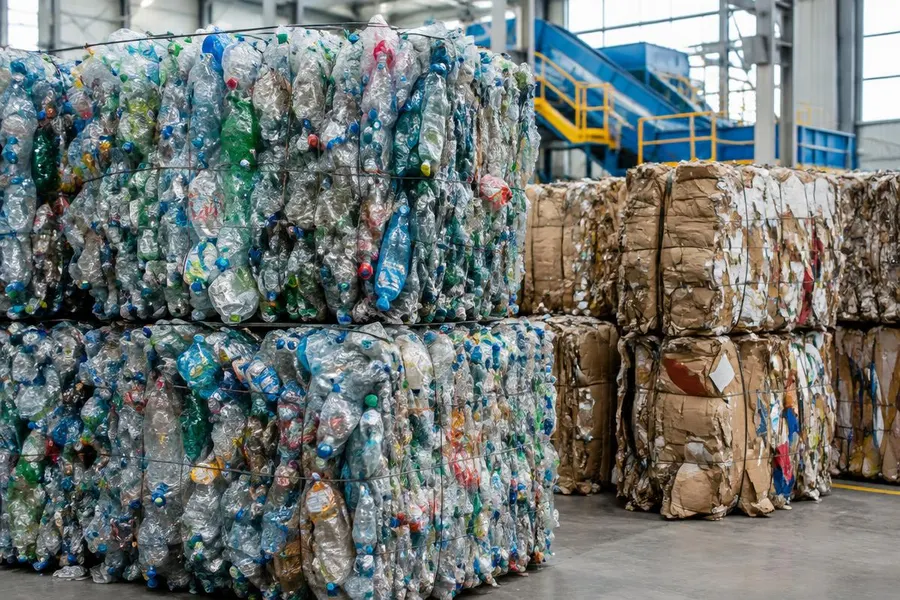
Legal reference: Regulation (EU) 2025/40. Refer to the current official text and applicable exceptions.
Article 29 sets targets for specified packaging from 2030, with exemptions and additional 2040 provisions. A reusable-packaging claim must meet the relevant Article 11 conditions.
Article 12 provides for harmonised material labels. The format and application date depend on the relevant implementing legislation; do not assume an unverified label template is final.
The producer placing packaging on a Member State market must assess registration and EPR obligations in that country. An authorised representative may be required where the producer is not established there — Articles 44 and 45.
Article 25 and Annex V restrict specified single-use plastic packaging formats. Definitions and exemptions matter; the list is not a blanket ban on all plastic packaging.
The manufacturer carries out the applicable conformity assessment before placing packaging on the market. Articles 38 and 39 and Annexes VII and VIII provide the documentation framework. Consultancy does not transfer the manufacturer’s legal responsibility.
Packaging description and intended use; design and manufacturing information; materials and components; applicable standards or technical solutions; assessment explanations; and test reports. Relevant documentation is retained for five years for single-use packaging and ten years for reusable packaging under Article 38(4).
Packaging identification; manufacturer and, where relevant, authorised representative details; statement of sole responsibility; applicable legislation and standards; place, date and signature.
Packaging inventory, legal-role assessment, applicable requirements and an evidence-gap report.
Review of substance evidence, risk-based testing plans and laboratory coordination.
Annex VII document structure, supplier evidence and preparation support for the Annex VIII declaration.
Design review, material alternatives and a phased improvement roadmap.
Practical PPWR sessions for purchasing, quality and export teams.
Align packaging data with LCA, product carbon footprint, CBAM and EcoVadis work where relevant.
Larger portfolios are scoped by packaging family and data quality. This is a consultancy service, not certification, independent conformity approval or official authorisation.
One packaging family, up to ten SKUs: inventory, economic operator role and applicable requirements.
Two to four weeks after complete data and supplier declarations are received. Laboratory testing, if needed, is scheduled separately.
Pre-compliance report; evidence-gap and risk list; Annex VII technical-file draft; and a 2030 roadmap with prioritised actions.

Sustainability Specialist · 15+ years of experience
Contact us to discuss your products, evidence gaps and EU customer requirements. This English content is general information, not a product-specific legal opinion or certification.
Assess scope and evidence separately. A “No” answer to a scope question is not counted as missing evidence. This is not a conformity approval.
0 checks assessed; 5 not yet assessed.
Next step: review the available evidence against the applicable requirements.
PPWR is Regulation (EU) 2025/40 on packaging and packaging waste. It entered into force on 11 February 2025 and generally applies from 12 August 2026 across EU Member States.
This depends on the legal role and how the packaging or packaged product is placed on the EU market. EU manufacturers or importers may request technical evidence from suppliers in Türkiye.
No. Article 5 PFAS restrictions concern food-contact packaging. The appropriate evidence depends on materials and the assessment of risk.
The packaging manufacturer issues it under Article 39 and Annex VIII. A consultant can support preparation but does not take over that responsibility.
No. Our service covers compliance consultancy, training and technical documentation support, not certification or official authorisation.
The Article 7 targets apply from 1 January 2030 or three years after the relevant implementing act enters into force, whichever is later. Higher targets apply for 2040, subject to the regulation’s provisions.
Share your company’s activities and customer requirements so we can define the assessment scope.
EUDR consultancy · CBAM reporting · EcoVadis consultancy · Life cycle assessment
English content updated: 11 October 2026. General information only. Applicable legal obligations must be confirmed for the specific product and economic operator.